
entangled roots, empty core
with Rumi, Jean Klein, and T. S. Eliot.
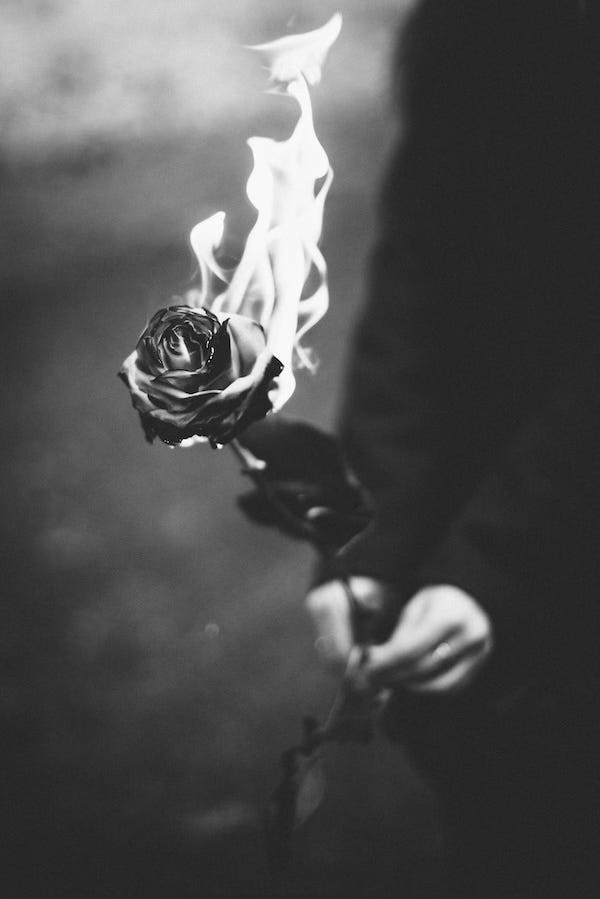
Thinking gives off smoke to prove the existence of fire. A mystic sits inside the burning. There are wonderful shapes in rising smoke that imagination loves to watch. But it’s a mistake to leave the fire for that flimsy sight. Stay here at the flame’s core. ~ Rumi
In the flame’s core no thing is known yet there is knowing. From this empty core of potential, flames emerge, dance, and return. Smoke adds nothing to its boundless mystery.
Like smoke, thought adds nothing to the boundless core of not-knowing that is knowing. Ask yourself: what can you really be certain of? Is it the smoke? The flame? Or the emptiness, the being-knowing from which smoke and flames arise. It is impossible to define, and yet it is, it must be.
We seek our certainty in the smoke of thought. But thoughts are merely a class of objects that come and go, kindred to sensations and perceptions. We want to believe in thought. We want inherently impermanent objects to give us a sense of stability. From the uncertainty of changing phenomena, we want certainty.
We seek, because we believe that objects are real, real things outside of ourselves. We think of ourselves as an object amid these objects: a separate body-mind. Identified with this mortal body, we fear death. Naturally, we want to control how our separate life will unfold. We endeavor to optimize for fulfillment through thought, sensation, perception; myself, other, world. Desire and avoidance are the drivers.
Not a single separate entity exists in this universe. What appears as a separate entity (me) is merely the way that reality expresses itself locally, as perceived by another apparent entity (you). Yet, despite intuiting there is more to this simplistic view, we believe our perceptions. We cling to our belief. We love to be pulled into the flimsy sight of smoke.
But we are looking for certainty in the wrong direction. The world cannot provide what we are looking for. Believing ourselves to be separate, we will always feel fragmented, incomplete, and lacking. We know something is off. We try to control the changes, the least we can do, so we think, but it is exhausting. Fear keeps arising, in ever subtler ways. Under the belief of a separate self, we are ever restless.
We can’t even be certain of what we see at any given moment. We only see our perceptions of things. Our senses are limited. We only see by a human scale, a scale optimized for survival, not for truth. Space-time, our reference for perception, falls apart in quantum physics. There is no certainty in this world. Phenomena cannot tell us anything about the truth of reality.
“We know very little for certain: I am. I am conscious. There is something rather than nothing. Is that sufficient to live happily and at peace? Yes. The solution to this is the discovery that psychological suffering is not due to something which is for certain but is predicated on belief systems and imaginations that have no experiential foundation. This is the path to liberation.” ~ Francis Lucille
Yet we are so habituated to the certainty of our separative view, that we love the belief in our separateness more than we welcome the truth.
Until we leave the seductive sight of smoke. Until we are willing to sit inside the burning.
Phenomena have nothing to offer. They cannot tell you who you are. All perceptions, sensations, and thoughts appear in you. Just as neither a photograph nor a camera can tell us anything about the photographer, we cannot know who or what we are by relying on thought, sensation, perception.
We are. We know that we are. And this is our only certainty. The rest? What a relief to say, I am not sure. What a relief to realize, we don’t need to know more.
In a world full of people who seem to know everything, passionately, based on little (often slanted) information, where certainty is often mistaken for power, what a relief it is to be in the company of someone confident enough to stay unsure (that is, perpetually curious). ~ Excerpt from A Swim in a Pond in the Rain by George Saunders.
World maps created in the mid or late 1400s were filled with images of monsters, treasure chests, and fabled trees and animals. They were beautiful works of the imagination. The cartographers sought to deliver certainty. The smoke of imagery gave stability amid the uncertainty of Middle-Ages life.
In the early 1500s, empty-space maps made their debut. What was not yet known was not filled in. Fewer assumptions were made. Now could begin the humbling task of real world discovery. Beginner’s mind. Genuine curiosity. The same would occur in science and the arts. Thus innovation and creativity could accelerate.
Beginner’s mind applies equally to the level of being, reality, the imperturbable background of phenomena.
Live in emptiness, free from images, and you will come to feel fullness. While there is objectification you cannot live in fullness. It is beautiful to live in nothingness, to be nothing. To live in emptiness means to live free of all images, free from all points of view, free even of the idea of nothingness. ~Jean Klein
Leaning into not-knowing. The unknown as a void, not to be filled in, but as the presence that is and that we are. Empty yet dancing. Boundless and constellating in ten thousand apparently bounded things. Attending. Tenderness for what is. No thing needs to be added. No thing is needed from what is the case. Daring to question belief.
What if we could live simply live in and as borderless core of not-knowing? What if being were enough? What if we could allow what is as it is without judgment?
An openness without anyone who is open. An emptiness that is everything and knows no personal separate identity. An emptiness that creates its own fullness. That is being, and is knowing of being, not-knowing of things.
My voice is born repeatedly in the fields of uncertainty.
~ Terry Tempest Williams
This is not theory. This is not a denial of the world. This is not about the factual knowing on how to drive a car. This is, rather, and in fact, a courageous openness to truly apperceive the nature of reality, and therefore the nature of the world, the nature of us. We cannot apperceive with mind. What is essential is invisible to the eye, as Saint-Exupéry wrote. But once we see, we cannot unsee. Once we see, all other questions fall in place. The world will be the same, and we will be the same. And yet we and the world will also be understood in a very different way. We and the world will, at last, be seen to be deeply loved. As was ever the case.
Love is a place, and through this place of love flow, with brightness of peace, all places. Yes is a world, and in this world of yes live, skilfully curled, all worlds. ~ e.e. cummings
I have no beginning, middle, or end;
I have never been, nor will ever be, bound.
My nature is stainless; I’m Purity itself.
This I know as a certainty.
~ Song of the Avadhut
What can apperceive reality, if not the mind? It has to be ‘something’ we can be certain of. It has to be at least as certain, if not more, as reality itself. Only being-knowing qualifies. This is our reality. This is the reality that apperceives itself. It has been called Awareness, the Self, God, the Absolute. This can be useful, but it cannot be adequately named.
This unknowable, unnamable reality of being and knowing is shared by all and everything. It is pure essence. It cannot not be. It is the flame’s empty boundless core. It also dances as a world. It is reality, unlimited, perceiving itself alone, complete onto itself. It is no thing, and it is everything.
Being-Knowing knows itself alone. Being what is, without the possibility of other, it loves itself alone. Within this love, from love, temporary worlds arise. Qualities get assigned. Love sees itself through the perspectives of the ten thousand things.
Mud, debris, compost, entangled roots, and darkness simultaneously become orchids, butterflies, honey, hummingbirds, light and human creatures too. It’s all desired. It’s all ever and only a single choreography. It is empty, it is the fullest of full, and beautiful. It is our world.
With the drawing of this Love and the voice of this Calling....
We shall not cease from exploration
And the end of all our exploring
Will be to arrive where we started
And know the place for the first time.
Through the unknown, unremembered gate
When the last of earth left to discover
Is that which was the beginning;
The Little Gidding is the last of T. S. Eliot’s Four Quartets
(photo credit: vladimir fedotov | unsplash)